

If you have a newer iPhone, you might have noticed an extremely pernicious feature: the screen never. turns. off. It used to be that you at least had to tap the screen, raise it up, do something to see your notifications; now it’s always on, trying to grab your eye at all times.
It’s so pernicious because it just feels so unnecessary. After all, we’re already deep in the hole, we all know how it goes: We pick up our phone to do… something. Thirty minutes later, we’re still scrolling. We don’t decide to spend our time like that. We don’t particularly enjoy it. But we also realize we can’t seem to stop, and a lot of the time we blame ourselves.
But it’s not about us. None of this is a sign of weakness or lack of willpower.
It’s about addiction; we’re surrounded by companies who have spent years exploiting our data, exploiting our attention… exploiting us.
Turning the world into a Skinner box
About a century ago, pioneering behavioral psychologist B.F. Skinner built a series of operant conditioning chambers — now called Skinner boxes — to study behavior. In one set of experiments, he placed rats inside and trained them to press levers for food. When the lever reliably produced a pellet every single time, the rats learned quickly and pressed it consistently.
Then something unexpected happened when the food dispenser jammed and rewards became unpredictable. Instead of giving up, the rats pressed the lever obsessively — far more than when rewards were guaranteed. Skinner had discovered something profound: unpredictable rewards create more persistent behavior than predictable ones.
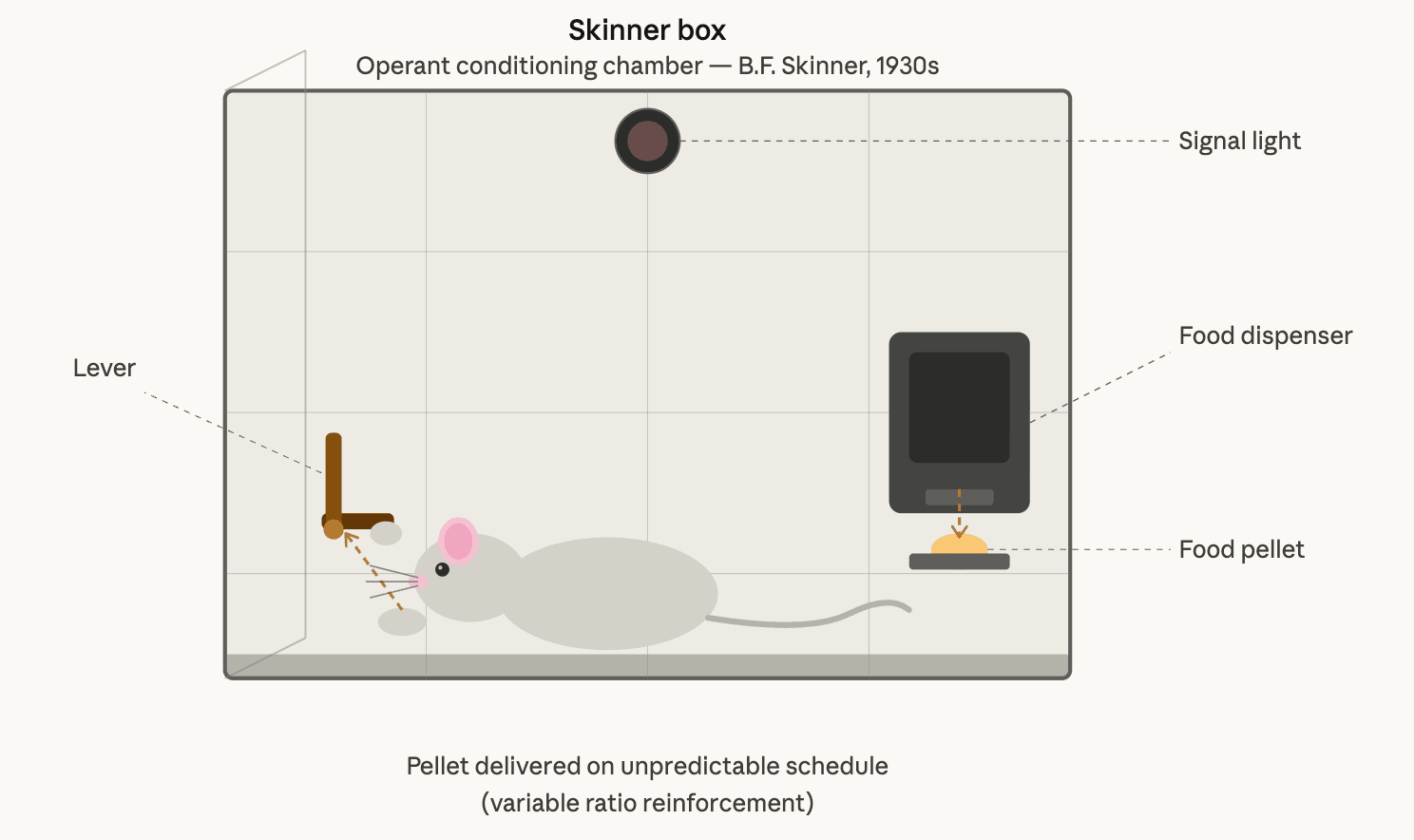
He called this a variable ratio reinforcement schedule. It is one of the most powerful behavior-conditioning mechanisms known to psychology. So maybe it’s no surprise that it has become the foundational design principle of every major social media platform.
The slot machine in your pocket
A slot machine works on a variable ratio schedule. You never know when you'll win. Sometimes nothing, sometimes a small payout, occasionally something bigger. Unpredictable rewards generate more sustained dopamine activity than predictable ones — which is precisely why slot machines are so addictive, and why your social media feed uses the same psychological principle.
As we scroll social media, we have that vague feeling that the next moment might show us something mildly interesting, or something that makes us laugh, or something that is genuinely important. That feeling persists, even as our rational brain, reflecting on how we spend our time, tells us that it’s a futile exercise. We keep scrolling because our brain is trying to crack the code, to get to that next reward. But the feed isn’t designed to give you rewards, it’s designed to trap you in the game, exactly like people sitting in a smoky casino, pulling the lever on a slot machine for hours on end.
This slot machine comparison is not just a metaphor we’ve started to understand. It's an accurate technical description of deliberate design choices.
For example, it has been reported that Instagram’s algorithm would withhold likes, instead delivering them to the user later on. Why? Because when you post something and initially see fewer likes than expected, your brain registers a negative prediction error. When a larger batch arrives later, the positive surprise feels even better than it would have otherwise. This goes beyond the simple dopamine rush of getting likes; it’s about engineering the platform to manipulate the entire emotional arc of the experience, not just giving you dopamine but timing - and increasing - its release.
These companies are taking advantage of exactly what Skinner identified in his experiments: Likes, notifications, and messages that arrive unpredictably are using the most powerful variable reinforcement schedule, driving us to habitually check social media in anticipation of a reward. It's not that you lack self-control. It's that billions of dollars have been spent on creating an experience that overrides your self-control.
Is it technically addiction? Does it matter?
I recently read an article from someone who worked in the online gambling industry, and was struck by how their words seem to apply to social media as well:
What has been legalized is extraction, and the new methods of extraction that are possible using the internet and mobile devices. These companies have identified a group of people with a monetizable compulsion, and we have legalized the tools needed to industrially harvest money from them.
Now, it’s true that there’s an ongoing debate about whether social media use constitutes genuine addiction in the clinical sense, or whether it represents a severe behavioral pattern that falls short of full pathology. Some researchers believe that the overuse of social media simply results in psychological and behavioral discomfort caused by improper or prolonged use, and that its symptoms have not yet reached the level of addiction.
But as a user, that seems to be splitting hairs. Pretty much anybody who has been watching what has happened over the past 15 years, as smartphones and social media have become absolutely ubiquitous in our societies, feels it. And the proof is starting to come in, even in legal terms:
Meta and Youtube were just found liable by a jury for deliberately designing addictive products
Another jury in a separate trial found that Meta “misled consumers over safety and enabled harm against users”
So whether our compulsive phone-checking qualifies as “clinical addiction” or not, it’s becoming quite clear that people are fed up with it. Unfortunately, we also know that variable reward conditioning - the mechanism that drives social media feeds - is extremely difficult to fight against.
What "designed against you" actually means
When people say that social media is designed to be addictive, it sometimes sounds like hyperbole or paranoia. It isn't. It is a precise technical description of the product design process.
The teams building these products employ behavioral psychologists, neuroscientists, and statisticians whose job is to maximize engagement — which means maximizing the compulsive checking behavior driven by variable reward schedules. Every design decision, from the infinite scroll (no natural stopping point) to the pull-to-refresh gesture (which mimics the physical action of a slot machine lever) to the unpredictable timing of notifications, has been tested and optimized for its effect on human behavior.
You are not weak. You are a human being with a brain that evolved over hundreds of thousands of years and is now being targeted by tools specifically engineered to exploit its deepest behavioral mechanisms.
So… what do we do about it?
Like any other addiction, awareness is a genuine first step — not because knowing the mechanism makes you immune, but because it changes the frame. You're not failing at self-discipline. You're up against industrial-scale behavioral engineering.
Beyond awareness, here are a few easy things you can do to push back against addictive social media:
Turn off all non-essential notifications (reducing the variable reward trigger). Switching off sounds and notifications can help un-ring Pavlov's proverbial bell and cull habitual checking behaviors.
Look for the "always on" motion-activated control that keeps trying to pull our attention to the screen - buried deep in the settings menu, no doubt - and turn it off. Consciously trying to check your phone at set intervals rather than reactively converts unpredictable reward anticipation into a predictable routine, which is far easier for your brain to manage.
Move social apps off your home screen. Having to swipe over to find them, rather than having them right there can help break the "grab and open" loop.
Put your phone charger in a relatively inconvenient place - i.e., not right next to your bed! - so that you can put your phone down and leave it for long stretches.
And of course, find (and use!) alternative products that aren't optimized for compulsion. Networks without algorithmic feeds designed to hold your attention, without engagement-maximizing notification strategies, without the infinite scroll. They exist. They're just not as loud.
