

Are you old enough to remember the exact heft and shape of the photo envelope from the pharmacy, holding those 36 photos from your holiday? Sitting in your car, shuffling through to see how they came out? Some would be blurry, others a bit out of focus, some genuinely beautiful… but all of them could become treasures, because that’s what you had.
A lot of times those photos would go into an album, the album went to a shelf. Today, years later, you can still pull it down, hearing that little crackling sound as two plastic-covered pages separate, holding those memories in your hands.
The disappearance happened quickly
Digital cameras arrived in the late 1990s and early 2000s and seemed, at first, like a pure improvement. More photos, no development cost, instant results. Then smartphones put a camera in every pocket, and the volume of photos taken per year went from billions to trillions.
And somewhere in that transition, the album disappeared. Not because we decided to stop making them — because the friction of making one quietly became infinite. You'd have to select from thousands of photos, find a printing service, wait for delivery, buy an album, organize the prints. Nobody had time. The photos stayed on the phone, waiting for the right moment to sit down and organize them.
Of course, that moment almost never arrives, which is why now the average person has thousands of unorganized photos on their device. Most of them will never be seen again. The holiday in Portugal in 2019, your daughter's third birthday, the weekend in the mountains — all technically preserved, but none actually accessible or shareable in any meaningful way.
What the photo album actually did
It's easy to be nostalgic about photo albums without being precise about why they mattered. Here's what used to happen.
A roll of 36 forced you to choose your shots. A pack of prints forced you to decide what was worth keeping. The constraint was a feature — it meant every album could be made quickly, as it was already edited down to the meaningful moments. Even if you decided to do, say, an album that looked back over your whole year, you’d probably only have 4 or 5 rolls - 100, 120, maybe 150 photos - to sort through. And you’d be able to do it physically, quickly picking this one, setting that one aside, jotting down a quick caption.
Once it was made, the album could tell a story. Sequenced, titled, sometimes annotated in handwriting at the margins, a photo album had a beginning, middle, and end. It was a narrative object, not a database.
That made them shareable in the truest sense. You sat with someone and looked through it together. There was a physical experience of sharing — turning pages, pointing at faces, laughing at haircuts. You can’t get that by sitting next to someone, scrolling through 800 unsorted JPEGs.
And albums lasted. Physical albums from the 1960s still exist. But your photos from, say, 2018: can you actually look at them easily? For most of us, the photos on our phone are pretty much inaccessible, whether they’re actually lost due to a busted phone or failed migration, or just lost in the waves of thousands upon thousands of other photos, all just thrown into our photo library.
The gap that opened up
For about twenty years, there was no good middle ground between the shoe box of unsorted prints and the professional photo book that took hours to design and cost €100. Cloud storage arrived and solved the preservation problem — your photos are safe, technically — but created a new one: they're safe and completely inert. Stored but not alive. Backed up but not shared.
The social networks promised to fill the gap. And for a while, Instagram felt like a solution — a curated visual diary, a shared album of life's highlights. Then the algorithm arrived, and it became something else entirely: a passive scroll, your feed optimized for influencers rather than sharing with friends.
The modern photo album
What people actually want — what they’ve always wanted — is simple: a beautiful, organized record of a trip or an event, easy to make and easy to share over time, whether with the people who were there or with others who matter to them. That's what Sunslider Albums is built to do.
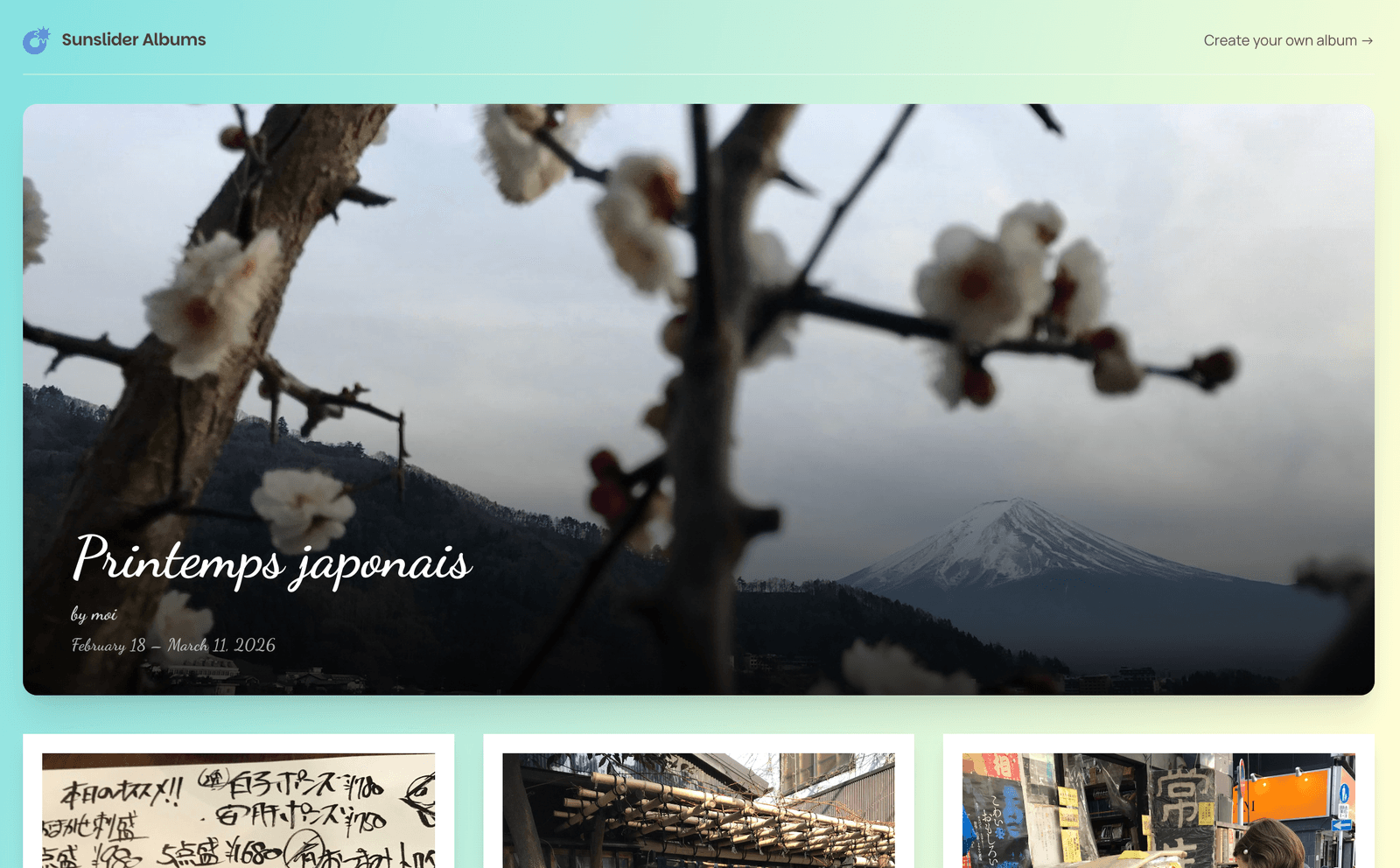
Upload your photos from a holiday, a birthday, a family gathering. The AI selects the best ones — the sharp ones, the well-composed ones, the ones that tell the story — and builds a beautiful album in minutes. You add captions if you want, and if there are a few special moments that didn’t get included, just drag-and-drop them in. Then you publish and share the link with your parents, your friends, the people who were there with you.
No printing required. No three-hour design session. No subscription. One album, five minutes, shareable with anyone.
The photo album didn't disappear because nobody wanted it anymore. It disappeared because nobody had time to make one. Now you do.