

Looking back, maybe calling it “the web” was a mistake. Sure, we all like the attractiveness of alliteration, and back then we weren’t really thinking in terms of “It’s a trap!”, but…
Because the web, as it exists today, really has gotten us all tangled up. And now we're sitting here, struggling, while pretty much everybody in the online game - from major tech companies all the way down to a local restaurant trying to win the algorithm - tries to squeeze as much out of us as possible.
We throw around numbers like “the average person spends 4-5 hours per day on their phone”, both nodding along and feeling pretty helpless when it comes to breaking free, just a bunch of little flies caught in the web.
We’re consuming, scrolling, watching a 47-second video of whatever and then the next and then the next, and then the next, ad infinitum (pun intended). It's a constant feedback loop that was engineered by very smart people, whether in San Francisco or Shanghai, to be as hard to escape as possible.
And seriously: it wasn’t always like this.
What actually happened
Even just 15 years ago, it wasn’t like this. Twitter was growing, Facebook was everywhere, yes, but people were still sharing. We’d spend too much time on those sites, the roots of addiction were always there, because we’re a social and (let’s face it) vain species. We'd post something, and start checking back to see if people reacted to it. But we’d also see what they were posting, maybe leave a comment, and then we'd go do something else because there wasn't really anything else to see at that point.
Those addictive roots didn’t have to be nurtured, watered, cross-germinated to become even stronger. There were many, many deliberate choices made to go in that direction.
...October 2012–we’re celebrating one billion people using Facebook. The festivities are really targeted at the lower-level employees. They get parties. Shiny silver and blue balloons–Bs and ones and zeros–float all around the office. But for top management, one billion users is a crisis. I’m in meeting after meeting where my bosses agonize about how we’re ‘running out of road’. That’s the phrase they use [...] They believe that the only way the stock price will rise is if we show growth, dramatic growth.
-- Sarah Wynn-Williams, Careless People, p.69
It’s not that we, collectively or individually, have chosen to spend more time online. It’s that the products we’re offered have changed underneath us in fundamental ways. The feed went from chronological to algorithmic, stories replaced posts, short-form video arrived and ate everything. Every one of those changes had a stated rationale — "better experience," "more relevant content" — and a real one: passive consumption is more monetizable than active sharing.
Think about it. When you're actively sharing — posting a photo, writing something, engaging with people you actually know — you're in control. You show up, you do the thing, you leave. There's a natural endpoint to that activity.
Passive scrolling, especially as facilitated by smartphones, has no natural endpoint. An algorithm optimizing for engagement doesn't let you ever feel satiated, it never wants to let you put your phone down. Its entire raison d’être is so that you never get that feeling, so your thumb just keeps on scrolling.
(By the by, this isn’t just a problem on social media. The range of products that have been designed to be addictive, using the same kind of mechanisms, is pretty wide: gaming, sure, prediction markets, obviously, but we can find the same principles applied in products such as food delivery apps. Scroll a bunch of attractive pictures, press a button, food shows up. The line between “creating a habit” and “addictive” is… pretty thin.)
So over the past decade, the tech world pivoted away from tools that helped people connect and toward tools that helped people consume. On social apps, sharing didn't go away entirely, but it got buried under an avalanche of content from people you don't know, ads dressed up as posts, and recommendations engineered to make you feel like you're missing out on something. And then AI got thrown into the mix – but that’s a different post.
Pretty much every extra minute that you and I have added to our screen time over the past 10ish years has been passive, because that’s what made some people the most money.
What sharing is actually supposed to be
Here's what I think digital sharing, done right, looks like: you open an app, you see what the people you care about have been up to, you share a bit of your own life, you leave a comment or two, and then you put your phone down and go back to living the life you're supposedly sharing.
5, maybe 10 minutes, that’s it.
The idea was never "you should spend all of your time online." It was "digital tools can make it easier to create and maintain relationships, letting you invest more energy in those relationships and less on the logistics of keeping in touch." That would’ve been a good thing!
Instead we got apps that deliberately erase the line between your real relationships and a never-ending content feed, because the moment you've seen everything your friends have posted, you might stop scrolling and thus not see the next 36 ads they want to show you.
That's what we're trying to fix with Sunslider. An app you visit for a few minutes, catch up with the people you've chosen to follow, share what you want to share, and then get out.
No algorithmic feed pulling you toward strangers.
No data being harvested to sell you things.
Just the people you actually know, in a chronological feed, on your terms.
And if you really want, hop over to the Explore feed to see what else is happening in the world.
And by the way, that same idea is baked into Albums. Smartphones have turned us all into picture-taking maniacs, but then we either spend hours sorting through them, or, much more likely, we let them rot on our camera roll because dealing with them is too much work. Albums wants to help you break that cycle: our tool uses machine learning (not AI! Just normal machine learning math 👼) to pick the best shots from whatever you upload; you edit the album as you see fit, add some captions if you’d like, and hit publish.
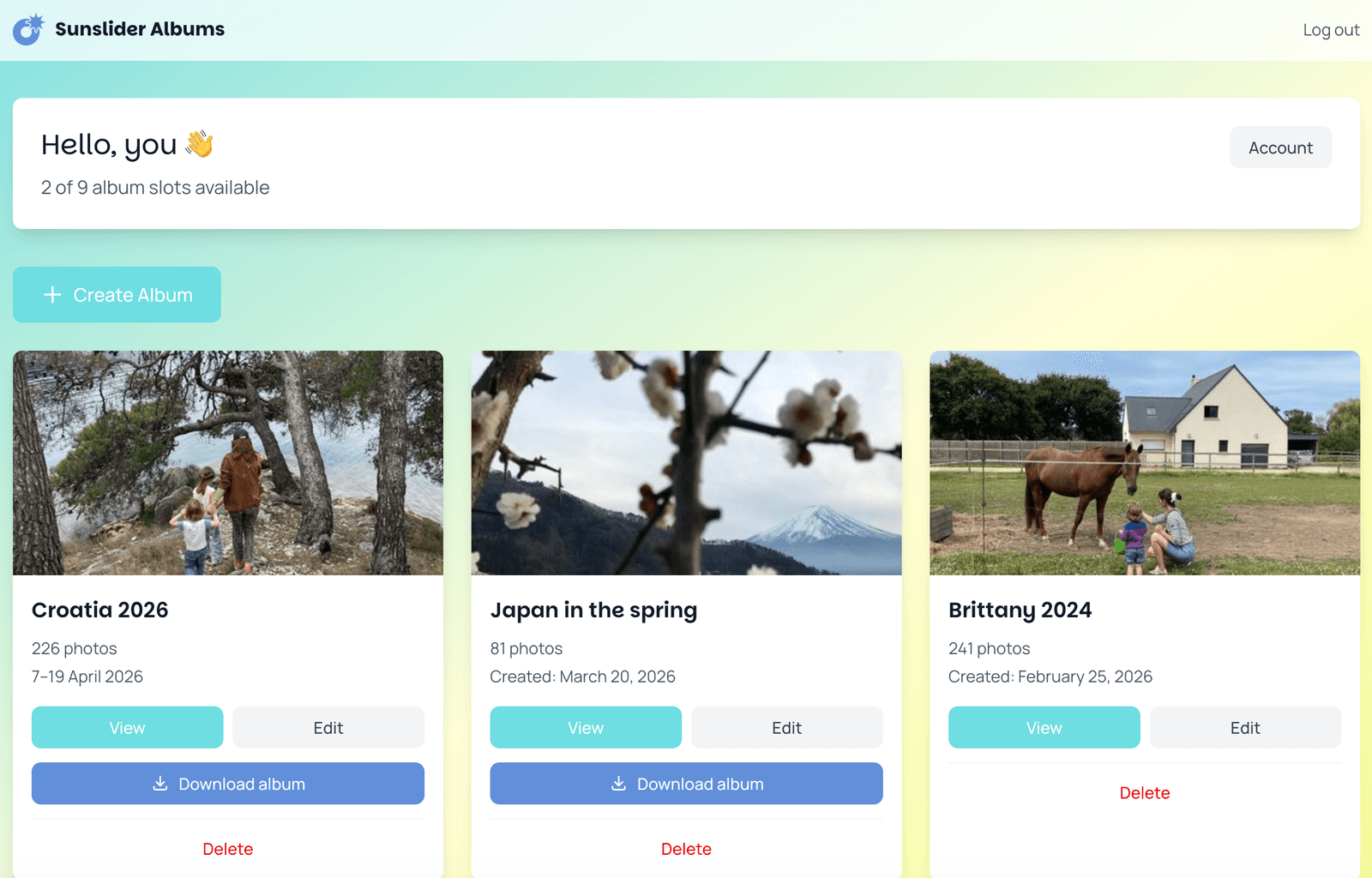
Anyone you share the link with can browse, and even download photos they want to keep (if you decide to turn that feature on). No more flooding the WhatsApp groups with a bunch of photos that eat up everyone's storage despite being unfindable just 12 hours later. Frictionless, active sharing, done.
The kind of online I want
I'm not anti-technology. I'm not even anti-social media, exactly (Ok, as I think about it, I kind of am? I want social networks, dammit, not social media!). At any rate, I'm definitely anti-the-specific-version-of-social-media that got built thanks to financial incentives pointed toward addiction rather than connection.
The good news is that it doesn't have to be that way. Maximum extraction is a choice, passive consumption is a choice, but they’re choices someone else made for you. But what you do with your time online can also be a choice you make for yourself. It’s possible to build tools that operate under a different logic, businesses that grow with a different ethos. We're doing it every day.